
Resources
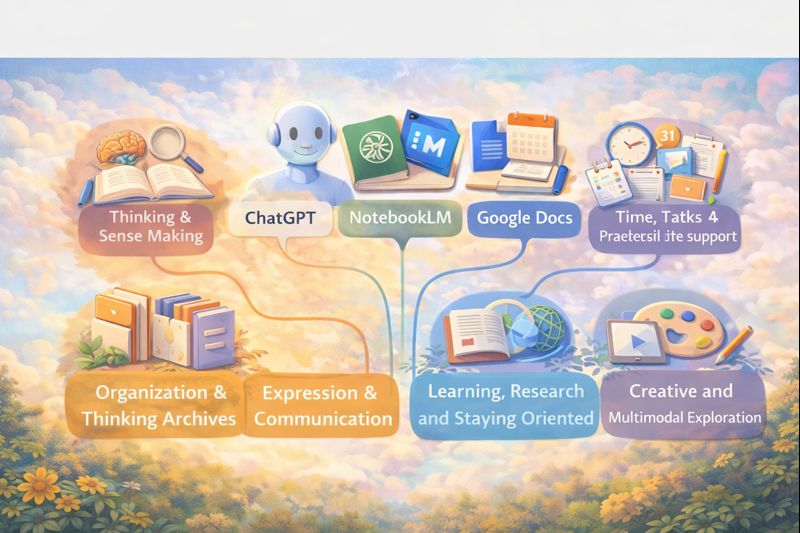
Tools to Think Clearly, Reduce Cognitive Load, and Build Capacity in the AI Era
This page is not a list of everything available.
It is a curated orientation to a small set of tools and practices that help people think more clearly, organize ideas, and work with AI in ways that are humane, practical, and sustainable.
Whether you are:
- exploring AI for the first time
- attending a free workshop
- navigating personal transitions
- teaching, creating, or running a small business
these resources are meant to support your thinking — not overwhelm it.
How to Use This Page
You do not need to learn every tool.
You do not need to “keep up.”
AI is most useful when it:
- reduces mental effort
- simplifies decisions
- helps you return to clarity
The sections below describe essential domains of use — areas where AI can genuinely support human work over the next several years.
You can engage with one domain at a time.
Nothing here requires technical expertise.
Core Domains Where AI Can Support You
A practical orientation for the next five years.
1. Thinking & Sense-Making
Making sense of complexity.
This is the most important domain.
AI can help you:
- think things through
- ask better questions
- clarify what matters
- slow down reactive thinking
This applies to:
- life decisions
- learning
- creative work
- professional problem-solving
Helpful tools
- ChatGPT — conversation and thought partner
- Claude — longer reflections and synthesis
- NotebookLM — working with your own notes, articles, or documents
If this domain is strong, everything else becomes easier.
2. Expression & Communication
Finding the right words.
AI can support you in:
- writing clearly
- refining language
- communicating ideas with confidence
This includes:
- emails
- essays
- presentations
- teaching materials
- websites or public writing
Helpful tools
- ChatGPT / Claude — drafting and revising language
- Canva — simple visuals or handouts (used lightly)
The goal is clarity — not performance.
3. Organization & Thinking Archives
Keeping your workbench clean.
AI works best when ideas are held with care over time.
These tools help you:
- organize thoughts
- return to ideas later
- avoid digital clutter
This applies to:
- students
- educators
- writers
- professionals
- lifelong learners
Helpful tools
- NotebookLM — store, organize, and synthesize your best thinking
- Google Docs — stable, distraction-free writing
- Notion — light organization for projects, notes, and planning
Choose one primary place to keep your thinking.
4. Time, Tasks & Practical Life Support
Reducing friction.
AI can help reduce the burden of:
- scheduling
- reminders
- repetitive tasks
This supports:
- personal organization
- caregiving
- teaching
- independent work
Helpful tools
- Google Calendar — time and commitments
- Notion — light task and project visibility
- Lindy — routine scheduling or follow-up (optional)
If a system increases stress, it’s not helping.
5. Learning, Research & Staying Oriented
Understanding what’s happening without overwhelm.
AI can help:
- summarize information
- clarify unfamiliar topics
- support research and learning
This applies to:
- students
- educators
- professionals
- anyone navigating change
Helpful tools
- Perplexity — fast, sourced research
- NotebookLM — synthesis you can return to
- Domain-specific tools — when precision is required
Awareness should feel grounding, not anxious.
6. Creative & Multimodal Exploration (Optional)
Exploring ideas in different forms.
Some people think better visually, audibly, or spatially.
AI can support:
- diagrams
- images
- audio or video experiments
Helpful tools
- Napkin.ai — visual thinking and mapping
- Image or video tools — conceptual illustration
- Audio tools — exploratory or creative use
These tools are optional.
They work best when clarity already exists.
7. Ethics, Judgment & Identity
Staying human in a powerful toolset.
AI changes how we think, create, and communicate.
What matters most is:
- integrity
- transparency
- discernment
AI should:
- support judgment
- not replace it
This domain governs all others.
A Simple Starting Point
The Minimum Viable AI Stack.
Most people only need a small set of tools to begin:
- ChatGPT — thinking and conversation
- NotebookLM — organizing and synthesizing your thinking
- Google Docs — writing and reflection
- Google Calendar — time and commitments
Everything else is optional.
A Final Orientation
AI is not about doing more.
It’s about doing what matters with less strain.
Choose fewer tools.
Use them gently.
Return to clarity often.
If you want guided support, explore Foundations, Studio Library, or Deep Dives — or begin with a free workshop.
Interested in attending or hosting a session?
All sessions are offered periodically in small groups and curated settings.
If you’re interested any of the sessions, you’re invited to submit a brief inquiry.
You’ll receive details about upcoming offerings, locations, and availability.
There’s no obligation. This is simply a way to express interest.
 Shanti Ajeet